• Pylon

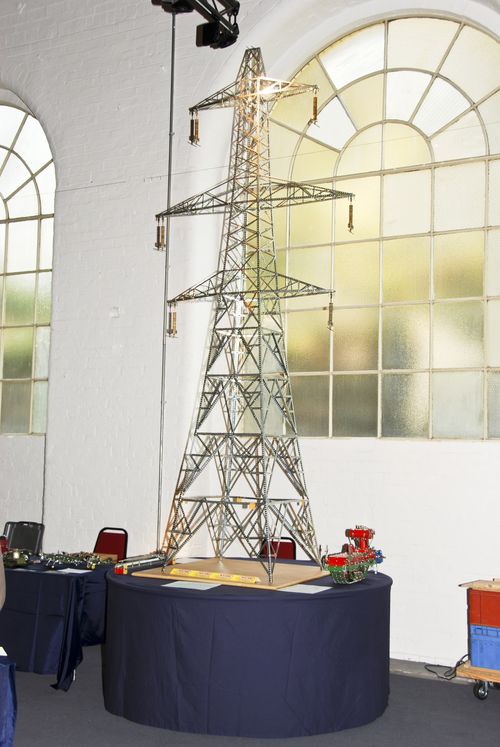
    Despite all my good intentions, November has almost passed by without a pylon and so here is one that I hope will also do for the festive season ahead.  There aren't any suitably wintry photos in my pending tray, but then I realised that a Meccano pylon would be perfect for Christmas.  It was built by Ken Senar and came to my attention via Ralph and Sue's Meccano website http://my-meccano.co.uk. If you have buying Christmas presents for children on your to do list and want to play your part in inspiring the next generation of engineers (and in the UK we need to raise our game on this front) then you could do worse than looking here for inspiration.

    According to Wikipedia:

    In 1901 Frank Hornby, a clerk from Liverpool, England, invented and patented a new toy called "Mechanics Made Easy" that was based on the principles of mechanical engineering.  It was a model construction kit consisting of perforated metal strips, plates and girders, with wheels, pulleys, gears, shaft collars and axles for mechanisms and motion, and nuts and bolts to connect the pieces.

    That is the same Frank Hornby behind Hornby model trains and if Meccano pylons don't inspire you, then you might be relieved to know that you can but Hornby pylons for your model railway kit.

    It hasn't been a great month for pylons in the news.  In Ireland, Somerset and Suffolk/Essex the tension between those who want electricity lines to be buried to preserve the landscape and those who will have to pay the extra cost of burying and then maintaining them continues.  I wouldn't want pylon lines running through some of my favourite parts of the UK, but given the pressure at the moment to drive down energy bills there has to be a recognition that infrastructure costs cannot be ignored.  In December 2012, the BBC reported that Ofgem had permitted £12 to be added to energy bills for the next eight years to pay for upgrades and maintenance and so pylon controversy looks set to continue for the foreseeable future.

    I don't want to end on that rather downbeat note and so I'll finish by mentioning this 'Electricity pylons in the mist at dawn' Christmas tree decoration which is the perfect present for pylon fans everywhere.
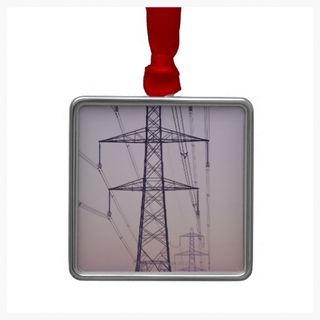
    Electricity_pylons_in_mist_at_dawn_ornament-r931bc62dd03c4fde8e38953e92bafd80_x7s2p_8byvr_512

  • Pylon
    After a break for the start of the academic year in September, Pylon of the Month is back with the first of the autumn international pylons.  This month, we in Bulgaria for the first time with another pylon sent in by a fan of the website.  For those who have visiting all the pylons of the month on a "things to do before I die" list, to tick this one off you need to go about 30km south of Bourgas on the Black sea.  You can get more details here via Google maps for when you start to plan the road trip. If you need a bit more information then according to Wikipedia you will be glad to know that:

    Burgàs or Bourgàs (Bulgarian: Бургас, pronounced [burˈɡas]) is the second-largest city on the Bulgarian Black Sea Coast and the fourth-largest in Bulgaria after Sofia, Plovdiv and Varna, with a population of 200,271, according to the 2011 census. It's the capital of Burgas Province and an important industrial, transport, cultural and tourist centre.

    It also has Lake Burgas (Bulgaria's largest lake) which looks a good bet for a spot of birdwatching.

    Electricity is quite a hot topic in Bulgaria at the moment with electricity prices being cut for the second time in July this year, much to the displeasure of the utility company and to the disappointment of many analysts.  Accoring to Reuters 'Electricity prices are politically sensitive in the Balkan
    country since power bills bite off a big chunk of monthly
    incomes, especially during the winter'
    .  Perhaps if Ed Milliband ever reads Pylon of the Month he can look at what is happening in Bulgaria as he looks to implement a fuel price freeze if he is elected in 2015. 

    I'm on a bit of a Bulgarian energy roll now and was surprised to discover that 40% of Bulgaria's power comes from nuclear power stations, largely because it is not particularly well endowed with coal, oil or gas.  As a result of its nuclear power stations, it is an exporter of electricity and again according to wikipedia 'plays an
    important role for the energy balance in the Balkans
    '. 

    If all this isn't enough, I can also point you towards an electricity pylon factory which is for sale in Bulgaria.  If you decide to buy it for 2,660,00 Euros do let me know how you get on.


  • Pylon
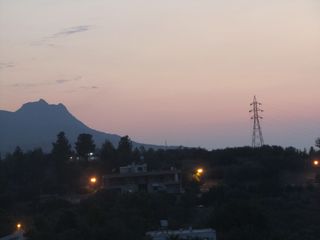
    It's that time of year again when I have to select the best pylon picture from my holiday snaps.  In some previous years, this hasn't been difficult because I only took one photo but this year my cup runneth over.  I could have gone for the close up with the sea in the background, or the wider angle shot with Kyrenia in the background but in the end I opted for the artistic twilight shot you see above.  It was taken from the Kybele restaurant in the grounds of Bellapais abbey in Northern Cyprus.  If you are looking for a restaurant with as view, then this is the place for you.  The views down from the Abbey towards Kyrenia/Girne are amazing and I really do recommend the Turkish Republic of Northern Cyprus (TRNC) as a holiday destnation.  

    The island of Cyprus is not without its problems and the TRNC issue is still a contentious one that I don't intend to go into here.  The TRNC wikipedia page is as good a place as anywhere to start looking into the issue:

    Northern Cyprus…….is a self declared state that comprises the northeastern part of the island of Cyprus. Recognised only by Turkey, Northern Cyprus is considered by the international community as occupied territory of the Republic of Cyprus.

    The village of Bellapais itself has a literary pedigree, courtesy of Lawrence Durrell who lived from 1953-56 and it is where he wrote Bitter Lemons, which Bookslut says:

    Might be his best "spirit of place" book. The tension between his love of the island and its genus loci (Aphrodite, Othello, waves of picaresque invaders of which the British are only the most recent) and the seemingly hopeless political problems he encounters there make for a sweet and sour masterpiece.

    If you go to Bellapas to look at Durrell's house (there is a plaque), then after the steep climb up from the centre of the village treat yourself to a drink at the fabulous Gardens of Ireni which is just around the corner.  The Brandy sours are highly recommended, as mixed by the wonderful Deidre who has lived there on and off since the 1950s and remembers Durrell from parties that her parents held.   

    On a rather more prosaic note, power has recently been in the news in the TRNC, with electricity being transferred from Turkey to try and reduce the cost on the island where it is about twice the cost of the Turkish mainland.  The biggest power station (120MW) on the island is oil fired and a recent oil spill near Famagusta has also attracted lots of bad publicity.

    Rather than finishing on that downbeat note, I'll leave you with this amusing video from Pagan Mo which I found on a Swedish website that recently mentioned Pylon of the Month and sent a bit of traffic my way.

    skipping pylons photo Pylons.gif 

  • IMG_1394
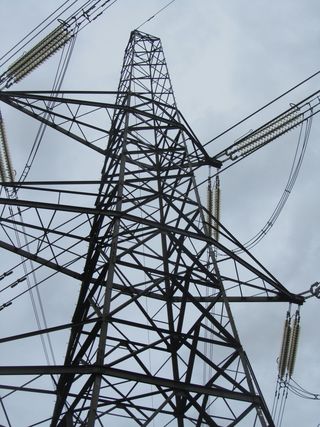
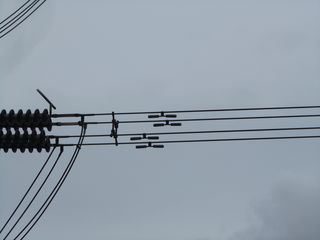
    This month's pylon comes from Kennington just outside Oxford and for reasons that will become obvious, I took it myself very recently.  It is very easy to find, being a few hundred metres from Sandford Lock on the Thames on the Sustrans cycle path from Abingdon to Oxford.  But the main reason I chose this pylon is because I could get a close up of something attached to the wires just before cables join the tower. Once you have seen the in the picture below, you will see them everywhere, but unless you are a real pylon spotter you have probably never noticed them before.

    IMG_1393
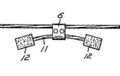
    The objects in question are the dumbell shaped objects and they are known as Stockbridge dampers or dog bone dampers because of their shape.  They perform a vital role in preventing damage to the cables and in order to explain how they work, it is time for a little bit of theory.  Some readers of the blog might know that I am a Physics teacher, but I will try to stop myself from getting too carried away.  I'll also try to get the physics right without over complicating or over simplyfying things, which might not be as easy as it sounds.

    The basic problem is that wind blowing on the cables can make them vibrate, or more specifically vortex shedding on the leeward side leads to this undesirable effect.  It can do this in a number of ways, but one of the modes of oscillation is called Aeolion vibration or flutter.  The vibration has an amplitude of a few millimetres to a few centimetres (this is how far the cable moves up and down) and a frequency of anywhere between 3 – 150 Hertz (vibrations per second).  This kind of effect, where some a driving force (in this case the wind) causes something to vibrate at its natural frequency is very common.  If you have ever seen or heard a washing maching as the drum speeds up in the spin cycle, you might have noticed that there is at least one particular speed where the washing machine shakes violently.  The problems with the Millenium Bridge in London when it wobbled as people walked across it just after opening were also a variation on this theme. But the most dramatic example involving the wind is probably the collapse of the Tacoma Narrows Bridge and if you haven't seen a video of the wind induced oscillations, now would be a good time to tick that off your 'things to do before you die' list.  But back to pylons, because as you will know if you have ever bent a paperclip a few times, repeated stress can lead lead to the metal failing and in the case of pylons on a windy day (or more likely the cumulative effect of many windy days) this could lead to strands of the overhead power lines breaking.

    So how do Stockbridge dampers help?  In very simple terms, instead of the wire vibrating the masses on the end of the damper vibrate instead and so the cable vibrations are 'damped' or reduced in amplitude. The idea was invented by George H. Stockbridge in the 1920s and originally consisted of two small blocks of concrete on the end of a piece of metal wire.  

    250px-Stockbridge_patent_closeup

    The original US patent is an interesting read if you want to know more, but in the words of the inventor:

    My invention relates to means for preventing objectionable vibration in suspended cables, such as are used in electrical transmission lines and the like…..

    The wikipedia page on Stockbridge dampers also has more information, but there is much that I would like to find out about how they are used.  In particular, are all dampers the same or do they vary depending upon the specification of the cable?  If you work for National Grid and know the answer please do get in touch and if you had a real life Stockbridge damper that I could use when teaching about resonance in my Physics lessons, I would be extremely grateful.

    If this was all a bit too much information for the casual visitor to the website just looking for a new pylon picture then I can only apologise.  I hope that you can at least spot a few Stockbridge dampers on your pylon travels and if nothing else, it might make you realise that there is more to pylons than meets the eye.

  • 01 Allermoor

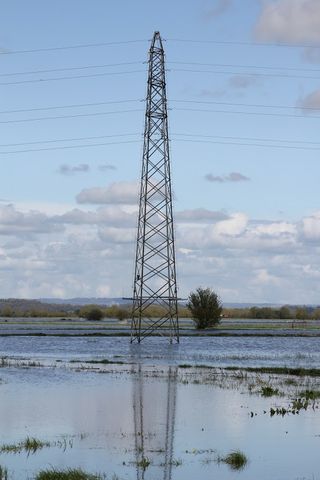
    This month's pylon comes from a fan of the website in Somerset and was taken almost exactly a year ago during the floods that affected Somerset in May 2012.  As the summer has started with much better weather so far (at least in Oxfordshire where I'm based) it seemed a good time to remind pylon followers of just how grim the summer was last year. The photograph was taken on Aller Moor and doing a bit of research led to my finding out quite a lot of new information about Somerset.  For a start, I had heard of the term the 'Somerset Levels' but had no idea what it meant.  I now know (courtesy of Wikipedia) that the more correct term is the 'Somerset Levels and Moors' and that the name Somerset may derive from the fact that in prehistory winter flooding meant that the area was only visited in summer. Hence Sumorsaete, meaning land of the summer people.  The 'levels' refers to the flat clay based areas near the coast with the moors being inland flood plains, as this month's pylon very clearly shows.  As a result, they are one of the most important inland wetland landscapes in Britain or even (according to the Visit Somerset website) in the world.   It is hard to credit that I have driven through the area on the M5 many times (most recently en route to Cornwall this Easter) and never realised that it is an area of such biodiversity and ecological importance.  There is even an ongoing attempt to reintroduce Cranes to the area and according to the Great Crane Project
    Cranes are wonderful, iconic birds that are sadly missing from many of their former wetland haunts in the UK.  They were lost as a breeding bird around 400 years ago as a result of the draining of their wetland nesting sites, and hunting for food.

    It is also tremendously important archeologically because the peaty soils are good for preserving ancient settlements.  So if you are in the area, once you have ticked off this month's pylon from your 'must see' list you there is no shortage of other things to do and places to visit.
     
    It would be remiss of me not to finish by mentioning that pylons are very much in the news in this part of the country.  The proposed pylon line to carry electricity from the new nuclear power station due to be built at Hinckley Point will have 50m tall pylons which will have a significant impact upon the landscape, not least because they are twice as tall as the current towers.   Local MPs are campaigning to have the tranmission lines buried underground, but given the costs of this I fear they are likely to be disappointed. Having said that, a five mile stretch in the Mendips has been earmarked for possible burial, so watch this space for updates during the rest of 2013 and beyond.

  • Pylon

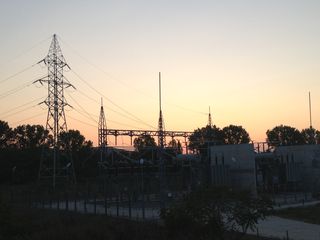
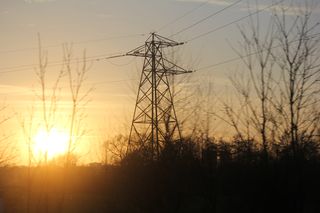
    This month's pylon comes to you from the M5 motorway.  It follows in the fine tradition of pylon photos taken whilst travelling, with the earliest example (from July 2009) being this one on the M6 motorway.  The fan of the website who submitted this month's photo said:

    This
    was photographed from the M5 whilst coming home on Friday evening.  I
    can't quite remember where it is but my best guess was somewhere between
    Gloucester and Birmingham.  I was actually trying some arty shots of the
    sunset, but the pylon sort of strayed into my shot.

    So a serendipitous photo rather than a planned pylon photo shoot, but Pylon of the Month is more than happy to accept any submissions whether deliberate or accidental. As the M5 has cropped up I feel that a bit more information is called for and I'll start with some construction history.  It is a rather messy story, but it starts in 1962 with the construction of a two lane motorway in Worcestshire and in the same year a section near Filton in Bristol was also opened.  This latter section of the M5 began addressing the traffic problems in Bristol dating back to the 1930s.  More details of the construction history and a rather splendid photograph of the first cars (led by the Lord Mayor of Bristol in his Daimler) precessing down the new Bristol section of the motorway via flickr and brizzle born and bred.

    In other pylon news this month, the bad weather in Scotland led to sheets of snow and ice damaging eight pylons in Argyll as reported by the BBC and many areas were without electricity for days.  Even if you aren't the biggest fan of pylons, you miss them if they meet the fate of the one below and your electricity supply is cut off as a result! 


    Argyll pylon

    There is plenty more that I could report but I'll leave it there this month.  You can after all get too much of a good thing, or as the saying (via Mary Poppins) goes in our house "enough is as good as a feast".  If you want to hear Mary Poppins say it herself then you can hear all four seconds of it here

  • WP_000178

    Happy New Year to Pylon of the Month fans everywhere.  After a busy festive season, January slipped away and so here is the first offering of 2013.  The picture was sent in by a fan of the website and I could hardly refuse to feature it when the email had this to say:

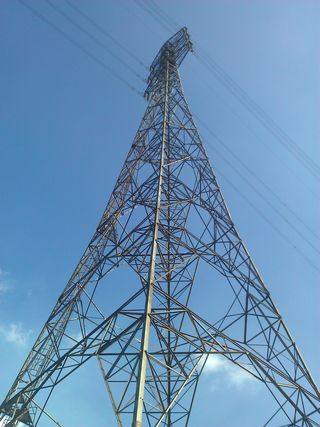
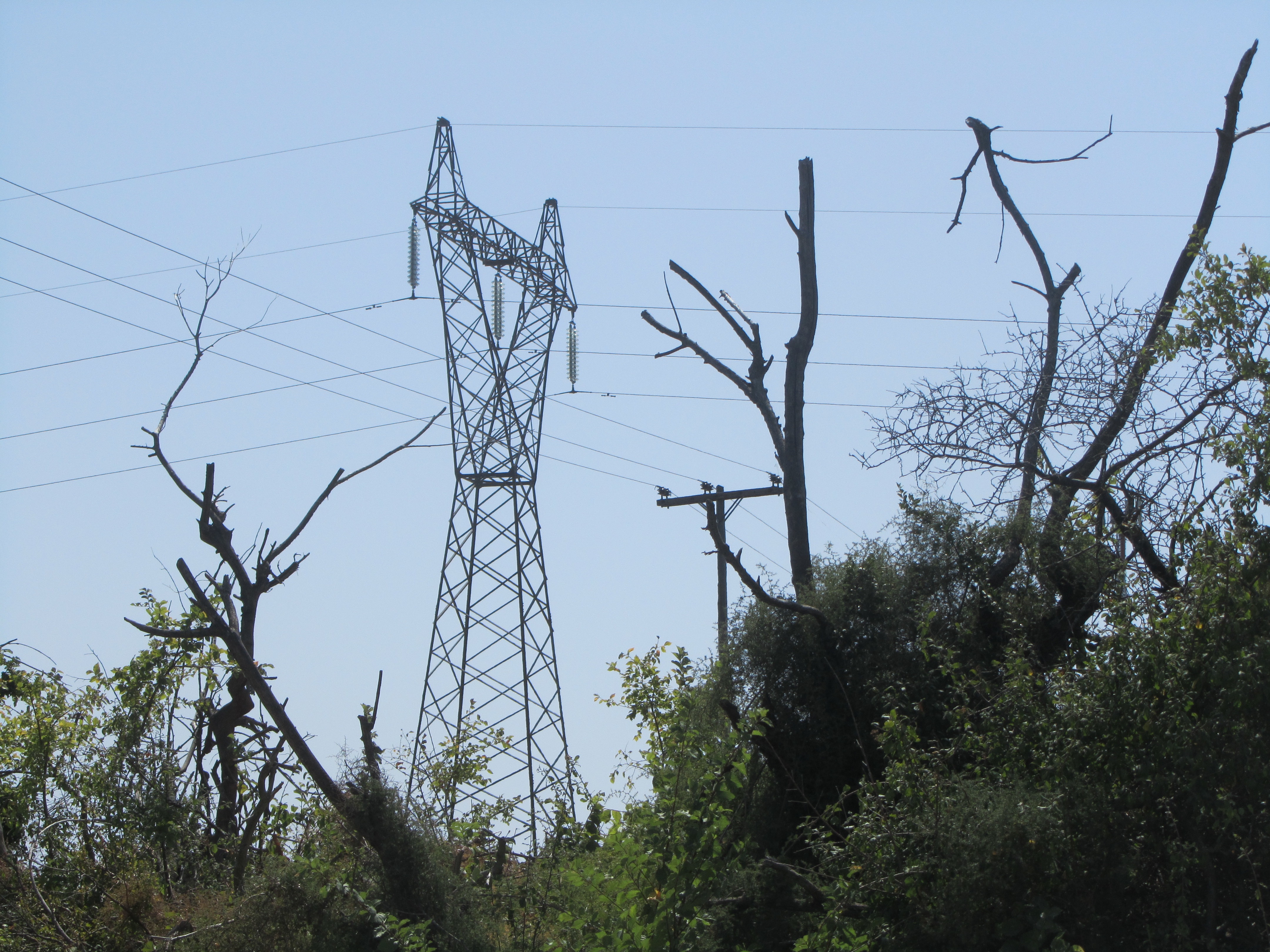
    This tower's days are severely numbered, it is one of the Tees crossing towers and is due to be dismantled in the new year. It is over 120m tall and over 50 years old. The pair of crossing towers will be replaced by  even bigger versions, carrying a modern high performance conductor.

    It looks to me as if this planning application is the one that deals with the replacement of the pylon over the River Tees, a river about which I knew nothing before writing this article.  As always, however, I learn something every day and so know I know that it rises in the North Pennines (near Cross Fell) and flows Eastwards for 85 miles to reach the North Sea between Hartlepool and Redcar.  The new crossing pylons will be 145m high and so according to this article they will be the tallest in the UK.  They are part of a £50 million pound project to upgrade and replace overhead power lines in the Middlesborough area which involves dismantling and replacing 14 pylons mainly between March and October 2013.  So if you are looking for bit more pylon action in your life this year then it looks as if Teeside is the place to be.

    If you can't make it to the North East then you can at least keep up with the latest thinking on pylon design from the National Grid.  You might remember the competition that took place in 2011 which was won by the T pylon, but further design work has ben ongoing and it looks as if the 'Flying T' has won out.  Read all about it here, but remember that you read about it first on Pylon of the Month.


    Tpylon_flyingT-300x102

  • Sunrise over mersey
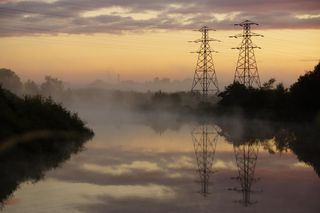
    Sometimes, a month passes so quickly that I never get around to posting a new pylon.  As a result I often get e-mails reminding me to update the blog (really I do; you know who you are…..).  Looking back through the archives, however, I was shocked to see that there has never been a December pylon of the month and I was determined to put that right.  With recent fans offering me pylon pictures from the Grand Canyon, Maryland and other exotic locations, I was tempted to head abroad again, but instead I am returning to the roots of this website with an ordinary British pylon.  I'm also heading up North back to my roots because it is a picture taken looking out from the A50 near Warrington towards the North East and I lived in nearby Leigh for a short time and in the North Manchester area for all of my childhood.  The A50 runs from Warrington to Leicester and the most exciting thing that I could find out about it was that a section of it between Stoke and Derby was originaly meant to be a new motorway, the M64, but the project was cancelled in the 1976 and so no such motorway exists.  Warrington itself has quite a lot to offer if you are in the area.  It has been a crossing point on the River Mersey since ancient times (and the river features in the picture above) and was also the site of the last Royalist victory of the English civil war on the 13th August 1651.

    The quality of the pictures on Pylon of the Month is quite variable, but this one is a real gem and well worth double clicking to appreciate in all its glory.  I'll use it as an excuse to link back to the most popular post on Pylon of the Month about Stephen Spender's poetry, because the Guardian article that described it was headlined "The gaunt, skeletal beauty of Pylons".  All over the world people seem to get set essays on Spender and his pylon poem and when you google 'Stephen Spender Pylon' out comes Pylon of the Month as the top hit. At least it did when I wrote this post and long may it continue.  Merry Christmas to pylon fans everywhere.  

  • Karol tattoo

    This month's Pylon is different for all kinds of reasons as I am sure all but the most unobservant of readers will have already have spotted.  After quite a few years of real pylons that you could actually go and visit if you were so inclined, that might prove more diffcult this month.  I have also kept the contributors to the website anonymous, but this month I'm happy to report that the pylon is tattooed on the arm of Karol Michalec from Brighton (as always, click on the photo for a larger version).  You can find out more at his website.  Although if you do go down to East Sussex to visit Karol, you could also visit the Patcham pylon that I mentioned only last month.  I've never really been tempted by body art myself, although as I'm due a mid-life crisis perhaps I should pre-empt it and visit my local tattoo parlour.  If I did, I'd be very tempted by a bubble chamber tattoo, although perhaps this equation for the momentum/position version of Heisenberg's uncertainty principle might be a bit more understated and stylish? 
    Tattoo-heisenberg
    Anyway, the other bit of pylon news this month relates to a book, The Beauty of Electricity Pylons in the Dutch Landscape, that I mentioned back in November 2009 after it featured in Alain De Botton's fantastic book, The Pleasures and Sorrows of Work.  One of the authors of the Dutch book (Anne Mieker Backer) has got in touch and so I now know that is published by De Hef in Rotterdam. So if you are looking for an unusual Christmas or birthday present for a Dutch speaking friend or family member then your search is over.  Full details here.
  • IMG_1013

    After a break for the month of August, Pylon of the Month returns for the new academic year.  This month's pylon is the blogging equivalent of the traditional "What I did on my Summer Holidays" essay that marks the return to school for so many pupils.  It is located on the Pelion peninsula in Greece where we spent two glorious weeks in July/August.  Lovely beaches, beautiful mountain scenery and a contrast between the calmer beaches of the Pagasitic Gulf and the more exposed outer part of the peninsula on the Aegean side.  If this sounds too good to be true then read this article from 2010.  We were staying in the rather lovely seaside town of Milina in Amelia's House, a property managed by Houses of Pelion.  If you find yourself in the area and fancy a bit of pylon spotting, this pylon is about 10-15 minutes outside Milina on the road to Arghalasti .
    As we are in Greece, it is worth mentioning (again for regular readers) that 'pylon' is a Greek word for the monumental gateway of an Egyptian temple.  Wikipedia has this to say on the subject:
    In ancient Egyptian theology, the pylon mirrored the hieroglyph for 'horizon' or akhet, which was a depiction of two hills "between which the sun rose and set." Consequently, it played a critical role in the symbolic architecture of a cult building which was associated with the place of recreation and rebirth. Pylons were often decorated with scenes emphasizing a king's authority since it was the public face of a cult building.

    If travelling to Egypt is too far for you, then there is always the Grade II listed Patcham Pylon, built in 1928 as a symbolic gateway to Brighton in southern England.  So next time someone makes a disparaging comment about pylons in your earshot, do be sure to ask them whether they are talking about electricity pylons or Greek temples.  If you really want to go to town on pylon etymology then more details are in my last post about a Greek pylon in August 2011, but remember to wear your learning lightly and to point them at Pylon of the Month for more information.