• IMG00525-20110407-1109

    It has been another busy month and I was wondering whether to skip a month (again), but then events took a rather interesting turn when Pylon of the Month was mentioned on the PM programme on BBC Radio 4.  The average number of page views per day is about 36, but yesterday (24th May) I managed to reach 1250!  So this post is rather closing the stable door after the horse has bolted, but here goes anyway……..

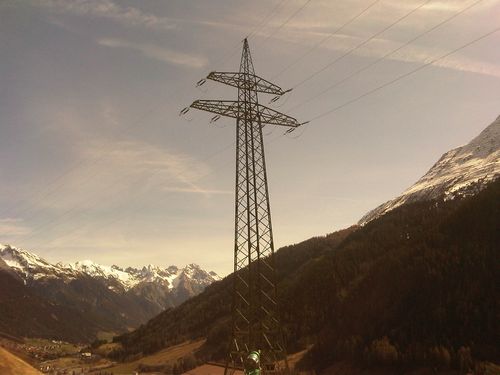
    This pylon is another one sent in by a fan of the website and it was taken in St Anton whilst on a skiing holiday.  For those looking to track it down, my corespondent further added that "it is on the
    side of the piste where the 2001 Downhill Skiing World Championships took place".  As you might expect for such a mountainous country, Austria produces over 50% of its power from hydropower.  If you want more details than that (and I know you do really) then I have discovered energy statistics heaven via the International Energy Agency (IEA) website.  In 2008 Austria produced 40678 GWh of hydroelectricity out of a total production of 67101GWh.  Look here if this has whetted your appetite.

    Pylons have been much in the news recently with the launch of a competition to design the pylons of the future.  As the Guardian headline put it, "National Grid hopes opposition to new electricity pylons can be headed off with 'more visually acceptable' design".  There are references to two pylon competitions covered previously on Pylon of the Month in Iceland and ItalyHugh Duttton, the designer who won the Italian competition, had this to say about the current design:

    "Traditional pylons are the very symbol of insensitive intervention of mankind on the landscape," he said. "These industrial soldiers that march across the countryside, galvanised steel trellis towers, are certainly optimal and efficient structures, but lack poetry."

    Lets hope that the competition results in a design that makes them more acceptable, but it is difficult to seee opposition going away completely.  As in so many areas of life, there is a degree of hypocrisy or 'wanting our cake and eating it' about the arguments.  We want the electricity carried by the pylons without being willing to pay the price in terms of visual impact.  But burying all the cables would be far too expensive, although (as long as someone else is paying) this remains a popular option in Areas of Outstanding Natural Beauty.  I await the results of the competition when they are announced in October.


  • Photo1651

    Where did March go?  Despite all my good intentions, I wasn't able to make time to post a pylon and as the first week of April slipped by I realised that something had to be done.  So here is another Australian pylon to follow on the back of the last one which successfully raised the profile of Pylon of the Month down under.  Last month I wrote:

    ….out of 32,781 visits since I started in June 2008 only 42 are from Australia.  …..30 are from Adelaide, 8 from Sydney, 2 from Brisbane and 1 each from Perth and Melbourne…..  I'll be watching over the next few weeks to see if this changes.

    Well I have been watching and here are the latest stats via Google Analytics from Australia (from 15th February until 7th April)


    Screen shot 2011-04-08 at 22.09.02

    So 327 visits from 11 cities is a pretty big improvement.  I won't mention the bounce rate, or the average time on site because I want to focus on the good news!  Yet again, Adelaide seems to be leading the way so it is definitely top of my list of cities to visit in Australia.  To be honest, it already was because I am a big cricket fan and would love to see a test at the Adelaide Oval and visit the surrounding wine growing regions.  

    This months pylon is at the Port Pirie lead smelting plant.  The supplier of the picture had this to say:

    That plant…..is the Port Pirie lead smelter, the largest in the
    world, and the flue to the right of the photo is 205m tall and is set a
    hundred metres or so back from the wharf (just to give you an idea of the
    size of the pylon. 

    The plant is owned by Nyrstar and (according to Wikipedia) also produces refined silver, zinc, copper and gold.  All these elements (along with lead) have a larger atomic number than Iron and so can only be produced when a massive star dies in a supernova explosion.  I'm not going to try to explain stellar nucleosynthesis here, but suffice to say that all the metals produced by the smelting plant at Port Pirie are recycled from the supernova that happened in our part of the universe billions of years ago.

    So there you have it.  Pylons, Australia, lead smelting and stellar nucleosynthesis. And some people think that Pylon of the Month is boring.

  • IMG_0939-1

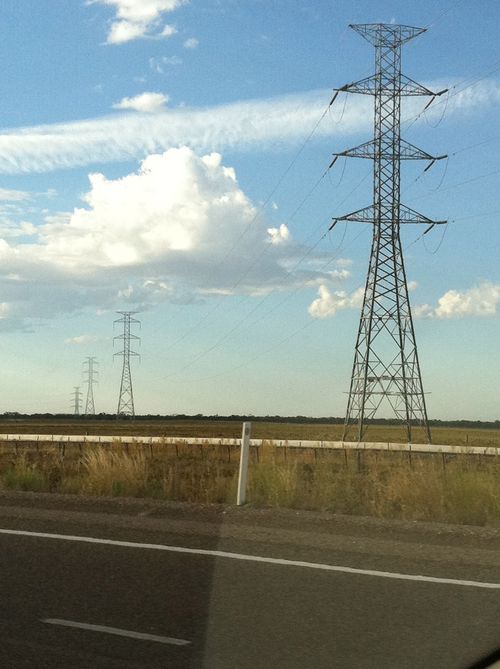
    This month's sees Pylon of the Month in the southern hemisphere for the first time.  A fan of the website from Australia sent this picture with the following information:

    "Here are a few snaps from a recent road trip from Adelaide, South Australia to Melbourne, Victoria."

    I use Google Analytics to see where my blog traffic is coming from and having just checked it, I can see that out of 32,781 visits since I started in June 2008 only 42 are from Australia.  If you really want to dig into the detail, 30 are from Adelaide, 8 from Sydney, 2 from Brisbane and 1 each from Perth and Melbourne.  The average time on the blog is just over a minute from Adelaide, but the lightweights from Brisbane can only hack it for an average of 27 seconds.  I'll be watching over the next few weeks to see if this changes.

    Like the UK, Australia has 240V 50Hz electricity, and here are a few electricity factoids for Australia (from the World Nuclear Association website, so perhaps not entirely independent).

    • Australia is heavily dependent on coal for electricity, more so than any other developed country except Denmark and Greece. Three quarters is derived from coal. 
    • Natural gas is increasingly used for electricity, especially in SA and WA. 
    • Australia has 27,640 km of transmission lines and cable (220 kV and above – 10,300 km 330 kV and above), mostly state-owned and operated, transporting 209 TWh* of electricity per year (2008-09).  There is no connection between the east of SA and WA.

    *TWh is Terawatt hours where Tera means 1 x 10¹² or a thousand billion.

  • DSCF0472

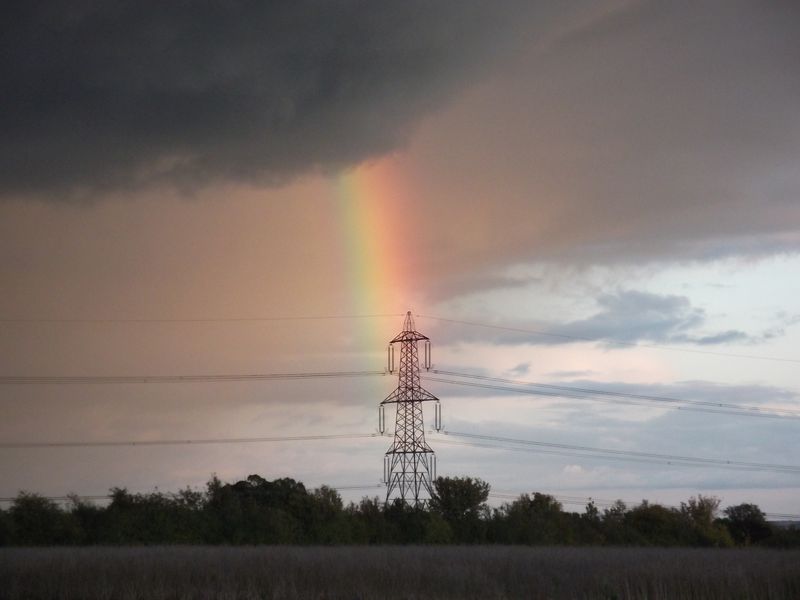
    Happy New Year to pylon fans everywhere.  After a Christmas break where I failed to get any pylon pictures with accompanying snow and ice I decided to start 2011 with this rather marvellous image taken by a pylon fan very close to Radley, a few miles outside Oxford.  

    I like it on a purely visual level and if all you want from Pylon of the Month is a chance to look at pictures of pylons then you might want to stop reading now. ……

    because the picture could also be seen as a metaphor for what some see as the battle between science and the arts.  I probably need to explain in a little more detail!  As I discussed in a recent post, pylons are frequently seen as the all to obvious symbols of technology riding roughshod over aesthetic and environmental concerns.  It was Keats who first used the rainbow in the argument between the arts and science when he accused Newton of destroying its beauty by explaining it.  It inspired Richard Dawkins to write 'Unweaving the Rainbow' which argues that understanding actually enhances our appreciation of the beauty rather than destroying it and I'm with him on this one.  Richard Feynman, one of my scientific heroes, also had this to say on the subject:

    Poets say science takes away from the beauty of the stars — mere globs of gas atoms. Nothing is "mere". I too can see the stars on a desert night, and feel them. But do I see less or more? The vastness of the heavens stretches my imagination — stuck on this carousel my little eye can catch one-million-year-old light. A vast pattern — of which I am a part… What is the pattern or the meaning or the why? It does not do harm to the mystery to know a little more about it. For far more marvelous is the truth than any artists of the past imagined it. Why do the poets of the present not speak of it? What men are poets who can speak of Jupiter if he were a man, but if he is an immense spinning sphere of methane and ammonia must be silent?

    So if you want to appreciate this month's pylon picture on a deeper level, then for more on the origin and background to Keat's comments, I can't recommend Richard Holme's book, 'The Age of Wonder' too highly.  Prior to this book, he was better known as a biographer of Romantic poets but this is an excellent account of the close interplay between science and the arts in the 18th and early 19th centuries.  For an account of the physics behind rainbows, here would be a good starting point.

  • USA Pylon resized

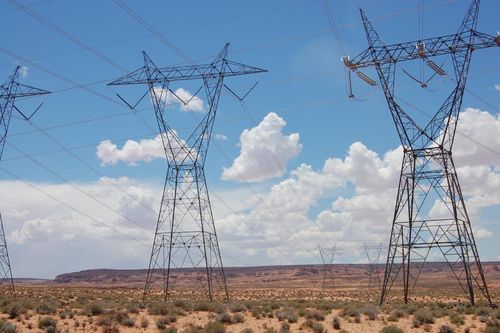
    After last month's rock and roll pylon, I decided to head abroad again with this picture submitted by yet another fan of the website.  The pylons are in the Arizona Desert near the City of Page ("the center of canyon country") and almost certainly carry electricity away from the coal fired Navajo Generating Station.

    You can tell that pylons aren't in the UK just from their design and after watching the fantastic Secret Life of the National Grid on the BBC this month, I am a little more aware of the thought that went into designing the UK pylons.  I have mentioned the the man behind the design before, architect Giles Gilbert Scott, although he is more famous for designing the famous red telephone box and Battersea Power Station.  What I didn't know until I watched the programme was that the word pylon comes from the Greek word for the monumental gateway to an Egyptian temple.

    I have to thank the BBC website for quite a lot of traffic recently (average page views per day is now at 28.93) and the Independent newspaper has also featured the blog in a couple of articles.  The first one brought to my attention was by Terence Blacker and was about the 'Secret Life of the National Grid' mentioned above.  Entitled 'Pylon fanciers will love this BBC propaganda'.  He says 'There are those who love pylons for their own sake. The more beautiful their rural setting, the happier the pylon-fanciers are.'  Whoa; steady on Terence.  I happen to be a passionate hill walker and climber and would not want to see pylons in the more beautiful areas of the UK.  In fact I'm inclined to agree with the point in your earlier article, that we put too low a value on the effect of pylons when doing the cost-benefit analysis, but there has to be a degree of realism.  I don't love pylons for their own sake, but I do think that we take the National Grid and the associated pylons for granted.  I also think that we undervalue engineers and the amazing things that they achieve in the UK.  And for what it's worth, I think we have the most aesthetically appealing pylons in the world.  At least, the TV critic of the Independent, Tom Sutcliffe, saw me in a more favourable light.  When reviewing 'The Secret Life of the National Grid', he wrote "I am grateful to it, though, for indirectly leading me to the Pylon of the Month blog – a celebration of global pylon design which proves that no object, however unlikely, is exempt from human enthusiasm." 

    There you have it in a nutshell. Not love, not worship, but enthusiasm.  An enthuiasm for pylons.  

  • Pylon cloudy

    After two recent posts about pylons that have not yet been built and a holiday pylon that was very much in the background, I felt that it was time to get back to a plain vanilla picture of a pylon.  The picture may not be anything unusual (although it is far from dull especially with the sky in the background), but this is a pylon that played a part in music history.  It was sent in by the a pylon fan at the legendary Bridge House II music venue in Canning Town East London.  This is the reincarnation of the original Bridge House, a pub that was the "premier pub rock venue of the 70's and the first pub in the world with its own record label". Paul Young and the Q-tips, Dire Straits, A Flock of Seagulls and Billy Bragg played there as did Iron Maiden (over 35 times with 3 different singers).   Even Mick Jager and Keith Richards drank there when supporting Charlie Watt's band, Rocket 88.  The pub has always had a pylon its logo as you can see below.  

    Pylons just don't get any more Rock and Roll than this.

    Bridgehouse_logo_black_clear

    Most pylons so far on Pylon of the Month have been in a field or by the side of a road and so can be quite difficult to track down.  As the new Bridge House has a postcode (E16 4ST) you can find this pylon on Google Maps and then zoom in on the satellite view, before clicking on the orange man by the +/- zoom controls to get a street view.  There are quite a few pylons nearby so you have to look carefully to make sure that you've got the right one.  Not quite as good as going along in person but if you're not planning to be in Canning Town anytime soon, it might have to do.

  • Sshot-1-jin's
     

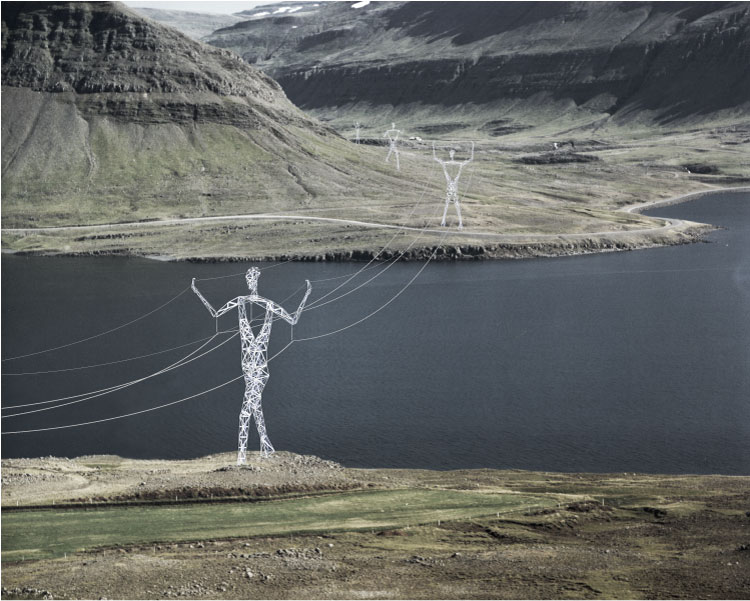
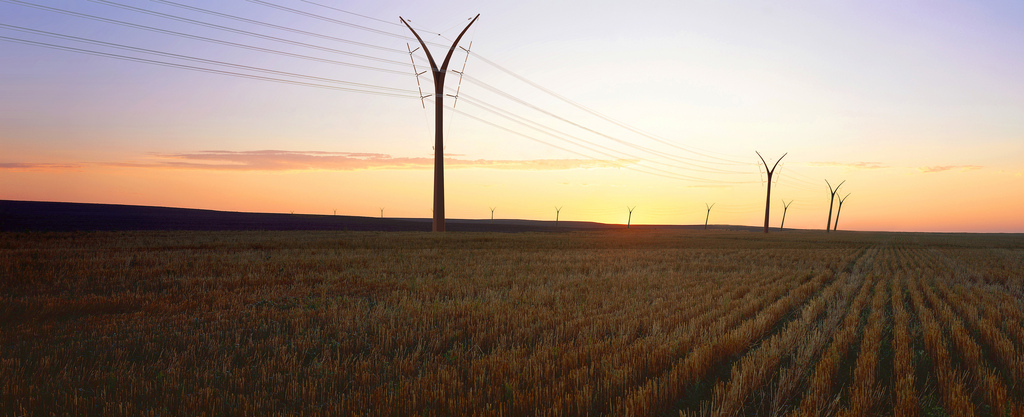
    August was an exciting month as Pylon of the Month got a mention on the BBC website.  As a result, the previous record for the number of page views in a day was smashed and now stands at 1355.  The BBC article was really about an innovative new pylon design that you can see above.  The design comes from the studio of Choi + Shine Architects and was a winner in the 2010 Boston Society of Architects Unbuilt Architecture competition.  It also received an honourable mention in the Icelandic High-Voltage Electrical Pylon International Design Competition.  Choi + Shine had this to say about the design:

    Like the statues of Easter Island, it is envisioned that these one hundred and fifty foot tall, modern caryatids will take on a quiet authority, belonging to their landscape yet serving the people, silently transporting electricity across all terrain, day and night, sunshine or snow. 


    Struts---pylon-3-(multi-position)
     

    The evidence of July's pylon and this one seem to indicate a growing interest in pylon design and long may it continue.  One of the benefits of the mention on the BBC website is that I have now gathered lots more pylon photos from fans of the website.  Next month, we'll get back to basics with a picture of a pylon that actually exists. 

  • P1010746

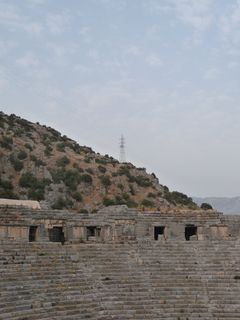
    Another August and another holiday pylon.  Like 2009, this one is from Turkey although from the Mediterranean rather than the Aegean coast.  The picture was taken overlooking the Roman theatre at the ruins of the Lycian town of Myra.  We were actually staying in Kalkan, about 90 minutes away, but a day trip allowed us to take in both Myra and the sunken city of Kekova.  For those keen to see even more Turkish pylons and who like the pylons to be more in the foreground than in this month's picture, look here.  Saint Nicholas (of Santa Claus fame) was the Bishop of Myra in the 4th Century and was a representative at the First Council of Nicaea in AD 325.  It was at this meeting that the timing of Easter was decided and which we still follow today.  Easter Sunday falls on the first Sunday after the first full moon following the vernal equinox (when day are night are of nearly equal length) which is why the date changes every year and is sometimes inconveniently early or late.  In the Gregorian calendar,  the latest it can possibly be is April 25th and this will not happen again until 2038 (it last happened in 1943).  Next year (2011), however, will see Easter Sunday fall just one day earlier on 24th April.  All this from a picture of a pylon…..


  • 4287861467_3b992095dd_b
     This month sees a departure from the normal for Pylon of the Month.  The picture above is of a pylon that has not yet been built.  It is, however, the winning design in the recent "Pylons of the Future" international competition run by Italian energy supplier Terna.  The picture comes from the winning design team, HDA Hugh Dutton Associés (download your own copy here).  Hugh Dutton gave this explanation of the design: 

    ‘Our own design response is based on changing the current ‘industrial soldier’ image of today’s pylons. Primarily by an elegant shape whose form is inspired by nature instead of galvanized trellises. And secondly by what I called “dancing with nature” where the pylons lean and swerve in response to the topography. They find a structural equilibrium by leaning into the curve of the electric cables as they follow the constraints of the landscape.’

    You can even watch a video about the wining design.

    An earlier post referred to the book The Pleasures and Sorrows of Work by Alain De Botton which has a very thoughtful discussion about a reluctance to see pylons as anything other than eyesores despite their elegant structure and importance to the way we live our lives now.  Jonathan Glancey (also mentioned previously) on Pylon of the Month) also covers this in an article from 1995.  Perhaps the new design of pylons will do something to change public perceptions.  Whilst I am on the subject of 'The Pleasures and Sorrows of Work', I must mention the wonderful exhibition of pictures from the book which is currently running at the Oxford History of Science Museum. The pictures are by Richard Baker and are accompanied by text from the book. The curator, Stephen Johnston, has produced a wonderfully thought provoking exhibition that is free to visit.  I can't recommend it strongly enough if you are in the Oxford area.  

  • IMG_0383

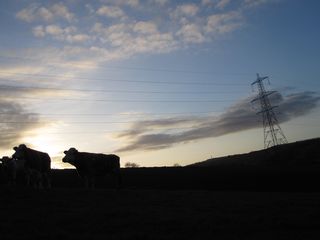
    As June is now with us and summer really does seem to be 'icumen in' I was drawn to this rather bucolic photograph submitted by a fan of the website.  It is just off the A38 (aka the Devon Expressway) between Exeter and Okehampton in Devon and so would be an ideal stop off for pylon fans heading to the West Country for their holidays this summer.  As far as I am aware, the cows are the first animals to feature in a pylon photograph on this website.  Another first for Pylon of the Month.

    Other than this month's pylon, my cup really does overfloweth with othyer pylon related news.  First up is a campaign to rebuild the Skylon.  Its not quite a giant pylon, but fans of large steel erections might want to vote on a suitable location for it if it does get rebuilt to mark the 60th anniversary of the Festival of Britain. It would certainly be a very visible reminder of the wealth of engineering and design talent in the UK.

    The second bit of news I discovered by looking at the sources of traffic for this blog.  It is mainly word of mouth (so people google 'pylon of the month' having already heard of it), but I do get the odd mention elsewhere.  One of the blogs that has been sending traffic my way recently is Wartime Housewife, which in a recent post discusses the origins of the National Grid and Sir Reginald Blomfield who was charged with deciding on pylon design.  The quote below is from Pastoral Peculiars by Peter Ashley (via Wartime Housewife above).

    If you had to design a tower to carry 400,000 volts worth of electricity, the pylon is not a bad solution.  Even at the start of the National Grid,  there were sensibilities about the impact of such things and they brought in Sir Reginald Blomfield to look at the design possibilities.  Blomfield had been on the Royal Fine Arts Commission that had chosen Giles Gilbert Scott’s design for the red telephone box and Scott, architect of Liverpool Cathedral and Battersea Power Station, has always been associated with the pylon project.

    I am going to make it my mission to find out more about the genesis of the pylon.