Photo-0013

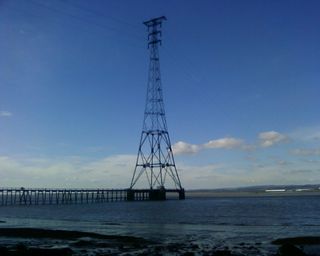
This month's pylon was yet again submitted by a fan of the website.  A waiting list is now developing and so if you have sent a picture then please be patient.  This picture was taken on the English side of the Old Severn Bridge.  Those keen to avoid mixing up their Severn crossings should go look here to avoid confusion.  The 'hammerhead shark' look of the pylon is quite interesting and unusual and any information on why it is designed like this would be very welcome.  With summer looming, I thought that it would be nice to have a seasonal element to the picture and it was the beautiful blue sky that made this one stand out from the crowd.

I also thought that I would also share another meaning of the word pylon with readers this month.  Apparently, it is "…..a new typographic term introduced to define the missing areas of a stencil typeface".  I'm pretty certain that this is a joke.  Look for yourself and decide http://thisisapylon.com/

Posted in

6 responses to “Pylon of the Month – May 2010”

  1. karen tweed Avatar
    karen tweed

    Dear Harvey,
    A friend sent me the BBC clip about your website and I loved it – and will never look at pylons in the same way again. Do you have a links section to your website? It’d be great to link my website to yours?
    Very best wishes
    Karen Tweed
    http://www.karentweed.com

    Like

  2. Kevin Mosedale Avatar
    Kevin Mosedale

    Hello Karen
    I’m not Harvey and as I haven’t had a chance to see the video clip, there must be some confusion as this is definitely my website. I’ll sort out a links section soon and feel free to link from your website. As I say in my blurb, Pylon of the Month is a little bit tongue in cheek but seems to attract lots of interest!
    Kevin

    Like

  3. Richard Ash Avatar
    Richard Ash

    As far as I know the ‘hammerhead shark’ look is there to carry two earth conductors, one over each set of phase conductors, rather than the normal single central earth wire. Normally these show up on the approach to substations, in order to provide enhanced lightning strike protection (the strike is supposed to hit the earth, mostly harmless, not the phases where is would cause flashovers), and on lines which cross open landscapes or ridges which make them more vulnerable to lightning strikes. I suspect given the immense height of the tower the lightning risk was seen as very high and so two earths were fitted (a number of other river crossings also have such earths, presumably for the same reason).

    Like

  4. Kevin Avatar

    Thanks for that – it makes sense to me and so I will look out for others of a similar design near a sub-station.

    Like

  5. Owen Rudge Avatar

    For what it’s worth, the pylons crossing the Forth at Kincardine appear to be of the same design – see Street View here: http://tinyurl.com/6fb9l9d

    Like

  6. vibram toe shoes Avatar

    yeah !!!!!!!
    Do you know!!!!!!!!!
    Comparing his fastball heat maps from 2010 and 2011—–what is that?

    Like

Leave a reply to karen tweed Cancel reply