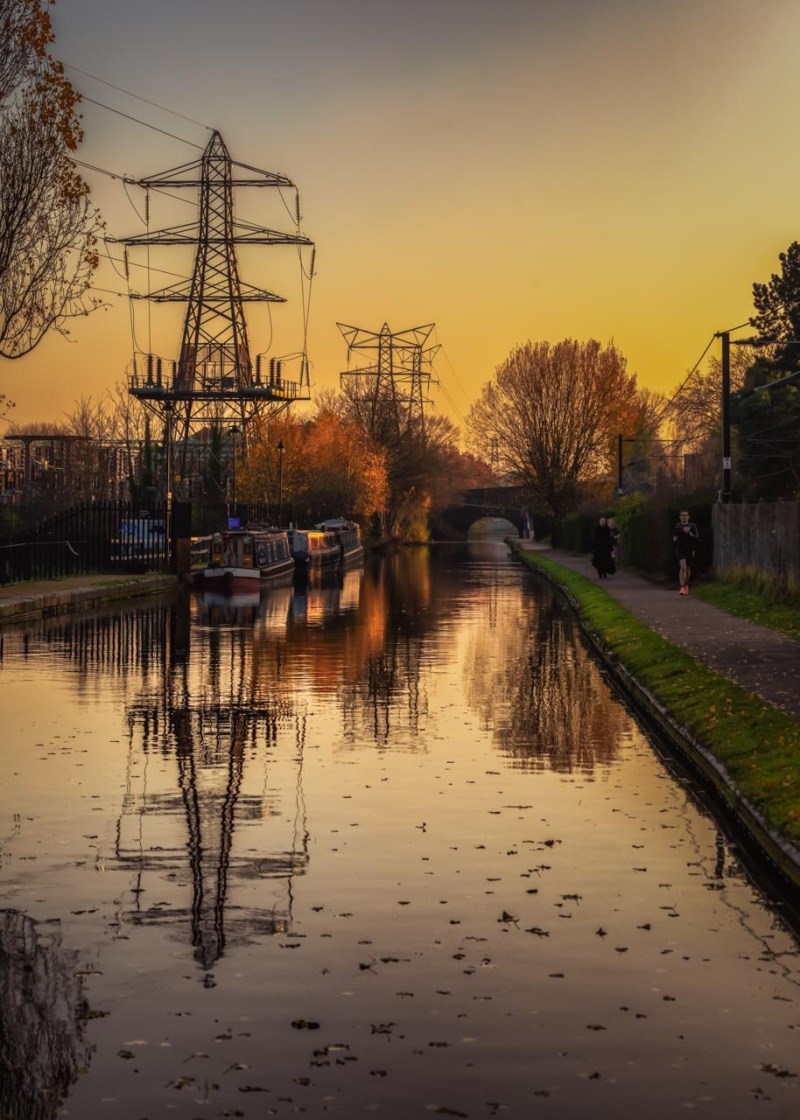
June's Pylon of the Month is an absolute cracker that I first came across on Twitter courtesy of @CPF_Photography who then kindly gave permission for me to use it. It was taken in Birmingham near one of the city's many canals and for more wonderful Birmingham photographs look on the CPF photography website. Let's deal with Birmingham and canals before we get into the pylons themselves. A quick google search will reveal claims that Birmingham has more canals than Venice with 35 miles of waterways compared to Venice's 26 miles. It turns out to be true but as the National Community Boats Association points out:
It’s at the heart of England’s canal network and has 35 miles of waterways so it does technically have more than the 26 miles of navigations you’ll find in Venice. But Birmingham is much bigger than Venice, so the density of canals there makes them a much more prominent feature of the city. Also, the canals of Venice are wide, whereas Birmingham’s waterways are narrow.
My elder son is at university in Birmingham and so I've been there quite a few times in the last couple of years, but the canals have yet to feature on my trip itinerary. That clearly needs to be rectified as soon as possible.
Now to more pylon related issues. The first thing that struck me when looking at the photograph is the wonderful reflection in the canal of the pylon in the foreground. More careful inspection revealed that this foreground pylon is a terminator pylon – the end of the line where the cables go down to finish at a sub-station rather than continuing to another pylon. This was quickly followed by noticing that the next two pylons further back look different with two 'ears' rather than a single apex. The two pylons further back are, however, a different line and I must confess at this point that I'm not entirely clear why they have two 'ears'. I do know that the thin wire running through the top of more standard pylons is an earth wire designed to protect the pylons from lightning strikes but why two? I look forward to learning more so that I can cross it off my 'things I still need to know about pylons' list. Despite all the time I've spent writing about pylons over the years and the fact that I'm a Physics teacher this is still quite a long list. Let me know if you can help to shorten it a little…..


 Pylon of the Month
Leave a reply to K A Mosedale Cancel reply